

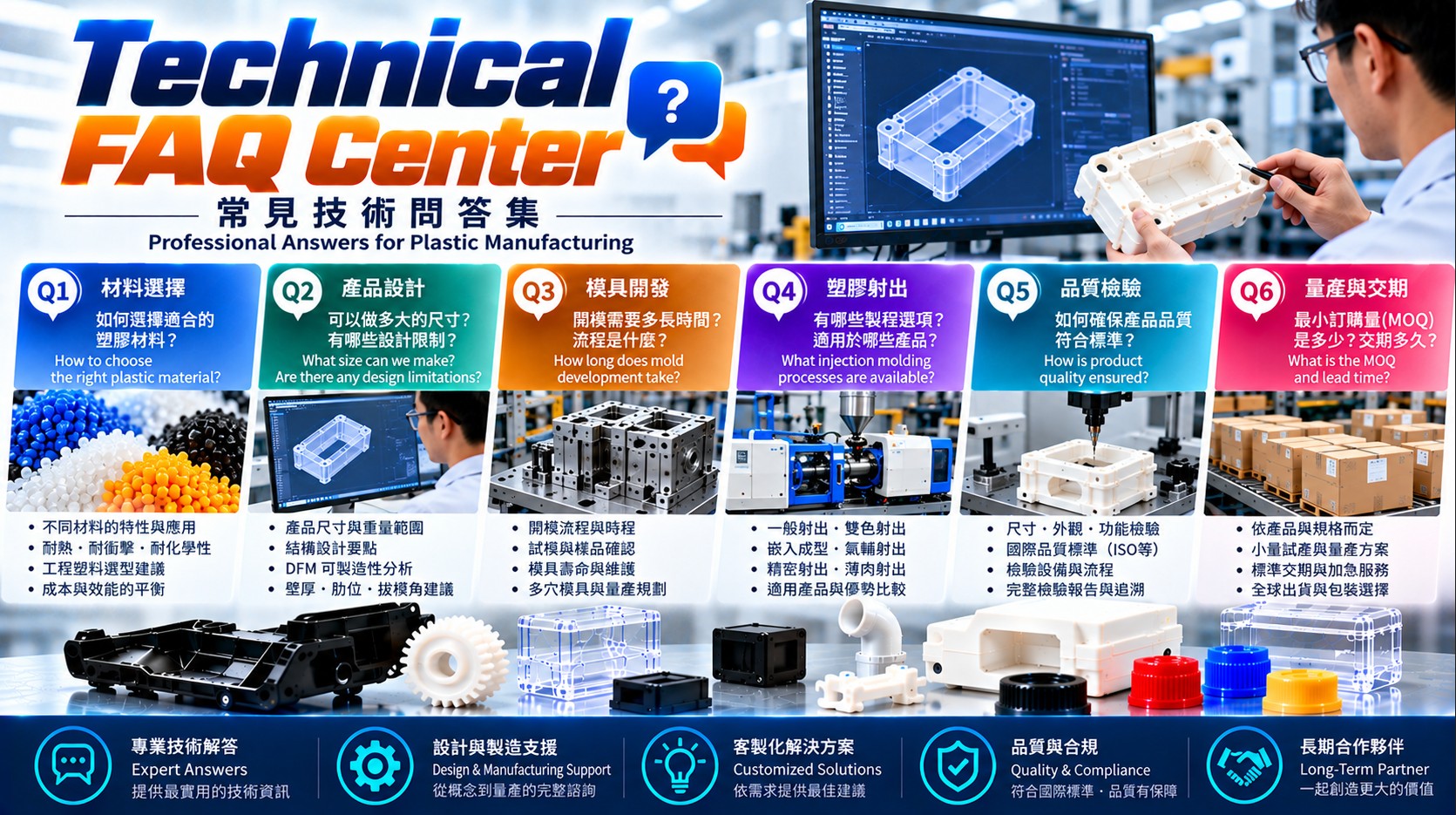
Plastic Injection Technical FAQs: Practical Answers on Tooling, Resins, and Manufacturing
Developing plastic products often raises a flurry of technical questions for R&D and procurement teams: "How long does new tooling take?", "Can you work from a conceptual sketch?", "Which plastic resin should I choose?". Established in 1978, Shun-Tung Industrial has addressed countless client inquiries over the decades. We’ve compiled our most frequently asked technical questions into this guide to provide direct, no-nonsense answers.
Table of Contents
Developing plastic products often raises a flurry of technical questions for R&D and procurement teams: "How long does new tooling take?", "Can you work from a conceptual sketch?", "Which plastic resin should I choose?". Established in 1978, Shun-Tung Industrial has addressed countless client inquiries over the decades. We’ve compiled our most frequently asked technical questions into this guide to provide direct, no-nonsense answers.
Table of Contents
- Why We Put Together This Technical FAQ Guide
- Three Core Steps in a Plastic Injection Project
- Key Technical Concerns for Procurement and R&D
- Why Global Clients Rely on Our Technical Expertise
- Frequently Asked Questions
Why We Put Together This Technical FAQ Guide
Teams searching for a trustworthy Taiwan Plastic Molding Supplier often stumble due to unfamiliarity with manufacturing nuances. A reliable manufacturer doesn’t just press buttons; they provide expert advice on draft angles, shrinkage, and timeline management. Clear technical insights ensure your Custom Plastic Injection Molding projects launch smoothly and on budget.
Three Core Steps in a Plastic Injection Project
To give you complete clarity when evaluating a new project, we break the workflow down into three essential phases:
| Project Phase | What We Do | Your Action & Benefit |
| 1.CAD Review & Feasibility | Analyze draft angles, wall thickness, and resin suitability | Confirms manufacturability and prevents costly tooling flaws |
| 2.Steel Tooling & Sampling | Cut precision steel molds and test-shot trial samples | Verifies exact dimensions and mechanical fit |
| 3.Production & Finishing | Execute injection, ultrasonic welding, assembly, and packaging | Delivers ready-to-market finished goods efficiently |
Key Technical Concerns for Procurement and R&D
In our daily manufacturing operations, client inquiries typically center around three critical pillars:
- Tooling Lead Times: Evaluating realistic working days required for mold machining and sample adjustments.
- Secondary Processing: Confirming whether ultrasonic welding, assembly, and printing can be done in-house.
- Volume Thresholds: Understanding how part size and resin choice affect Minimum Order Quantity (MOQ) requirements.
Why Global Clients Rely on Our Technical Expertise
We believe in straightforward communication. Decades of hands-on manufacturing experience allow us to diagnose potential production bottlenecks instantly, giving you reliable technical advice to keep your supply chain secure.
Frequently Asked Questions
No problem! Share your dimensions and core functional ideas with us, and our engineering team can help convert your sketches into production-ready 3D files.
Q2: How many working days does tooling and trial sampling take?
Tooling and sample testing typically require between 25 to 35 working days, depending on part complexity.
Q3: Can you perform ultrasonic welding and surface painting after molding?
Yes! We provide complete in-house secondary processing, including ultrasonic welding, assembly, pad printing, and soft-touch painting.
Q4: How is the Minimum Order Quantity (MOQ) determined?
MOQ varies depending on part size, tooling investment, and selected engineering resin. Send us your project details for a tailored evaluation.
