

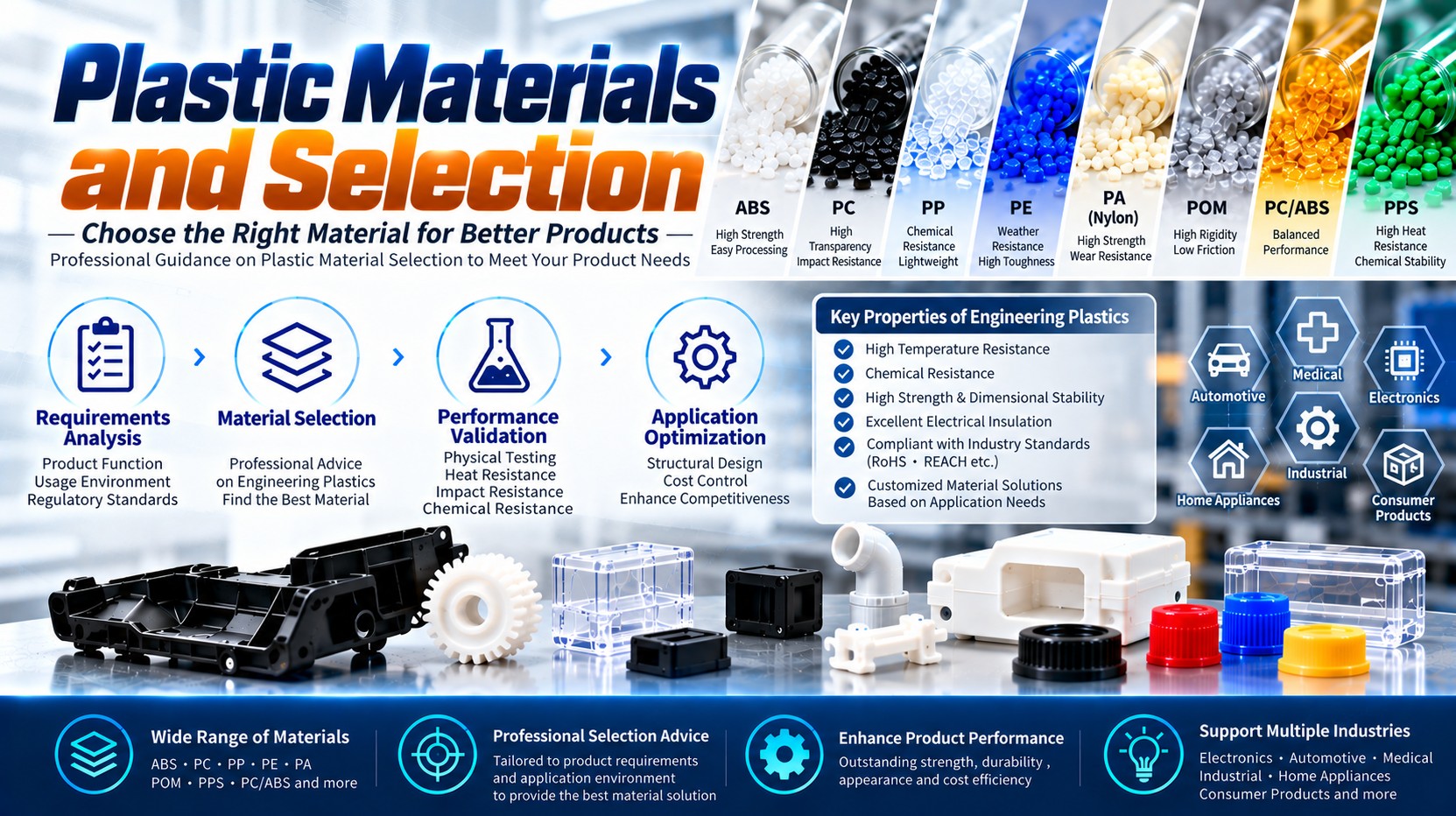
Plastic Materials and Engineering Resin Selection: Choosing the Right Polymer for Success
When developing a new plastic product, even the best 3D CAD design will fail if the wrong raw material is chosen. At Shun Tung Industrial, we always tell our clients: "Choosing the right plastic is half the battle won." Different product applications demand specific engineering resins. Here is our practical guide to selecting the most cost-effective and durable materials for your project.
Table of Contents
When developing a new plastic product, even the best 3D CAD design will fail if the wrong raw material is chosen. At Shun Tung Industrial, we always tell our clients: "Choosing the right plastic is half the battle won." Different product applications demand specific engineering resins. Here is our practical guide to selecting the most cost-effective and durable materials for your project.
Table of Contents
- Why Material Selection Dictates Product Success
- Our Step-by-Step Resin Evaluation Workflow
- Common Engineering Plastics and Their Ideal Applications
- Why Global Clients Rely on Our Material Expertise
- Frequently Asked Questions
Why Material Selection Dictates Product Success
The market offers countless polymer types, from general-purpose plastics to high-performance engineering resins, each with vastly different properties. If you are developing Precision Plastic Gear Parts, choosing standard PP will lead to rapid wear and failure. Conversely, selecting the right polymer for your Custom Plastic Injection Molding projects ensures optimal surface finish and impact resistance. Getting the material right from day one saves you from costly tooling remakes.
Our Step-by-Step Resin Evaluation Workflow
Before cutting any steel molds, we run a systematic evaluation to ensure the ideal material match:
The market offers countless polymer types, from general-purpose plastics to high-performance engineering resins, each with vastly different properties. If you are developing Precision Plastic Gear Parts, choosing standard PP will lead to rapid wear and failure. Conversely, selecting the right polymer for your Custom Plastic Injection Molding projects ensures optimal surface finish and impact resistance. Getting the material right from day one saves you from costly tooling remakes.
Our Step-by-Step Resin Evaluation Workflow
Before cutting any steel molds, we run a systematic evaluation to ensure the ideal material match:
| Evaluation Stage | What We Analyze | Your Benefit |
| 1.Functional Requirements | Assess temperature, impact resistance, and load needs | Ensures physical properties align with real-world use |
| 2.Moldability Check | Review resin fluidity, shrinkage rates, and mold release | Prevents warping, short shots, and surface defects |
| 3.Cost & Compliance | Balance budget targets with RoHS and REACH regulations | Meets target costs while satisfying international standards |
Common Engineering Plastics and Their Ideal Applications
Different resins have distinct characteristics. Here are the polymers we most frequently recommend to our clients:
- ABS: Excellent impact strength and easy finishing, making it the go-to choice for electronics and consumer housings.
- POM (Acetal): Exceptional wear resistance and self-lubricating properties, making it the ultimate material for gears and transmissions.
- PC / PC+ABS: High heat resistance and superior strength, ideal for rugged housings or medical-grade devices.
Why Global Clients Rely on Our Material Expertise
We don't push the most expensive materials; we recommend the right ones. Backed by decades of hands-on injection molding experience, we help you strike the perfect balance between cost, structural integrity, and aesthetics.
Frequently Asked Questions
No problem! Simply share your product's operating environment, load requirements, and budget, and our engineering team will recommend the ideal resin.
Q2: Must plastic gears always be made of POM?
Not strictly, but POM's low friction coefficient and high wear resistance make it the industry gold standard for precision gears.
Q3: Are your raw materials compliant with environmental standards?
Yes, our trusted resin suppliers provide full compliance documentation, including RoHS, REACH, and Technical Data Sheets (TDS).
Q4: Will changing the plastic resin affect an existing mold's dimensions?
Yes. Different resins have varying shrinkage rates. Changing resins after tooling is completed may require mold modifications, making early material selection critical.
